OPINION: This article may contain commentary which reflects the author’s opinion.
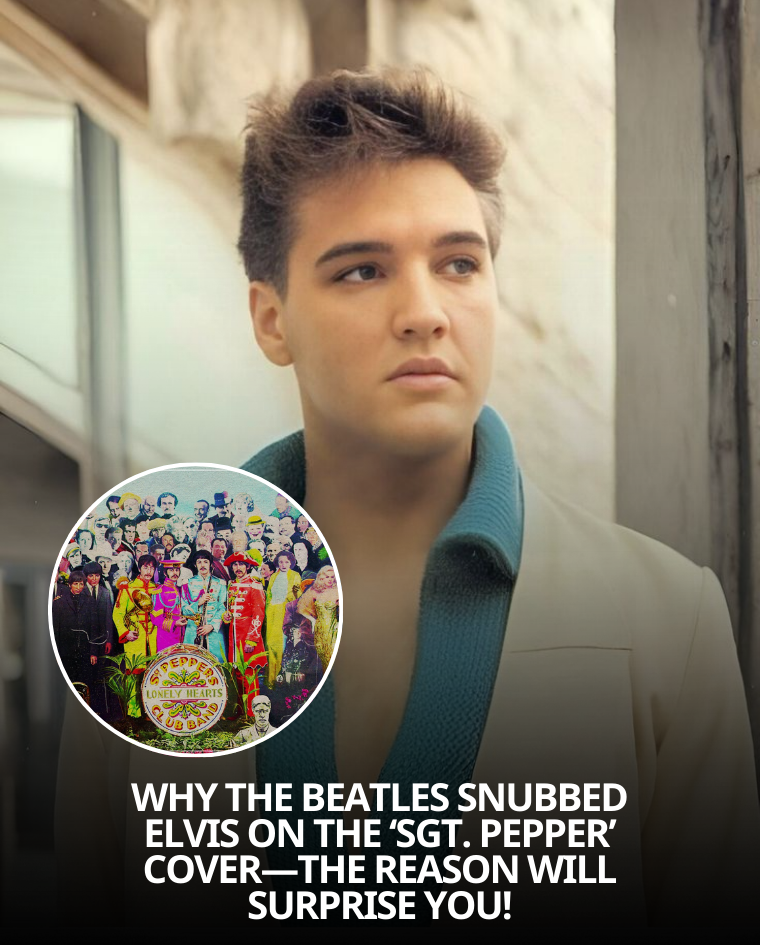
The album cover for Sgt. Pepper’s Lonely Hearts Club Band is one of the most iconic pieces of art in the history of music. It’s a visual representation of The Beatles’ evolution and their cultural significance in 1967, capturing the essence of a band that was pushing the boundaries of creativity and revolutionizing the music scene. But there’s one glaring absence on that cover that continues to spark curiosity: Why isn’t Elvis Presley, the King of Rock and Roll, featured?
The album’s cover, designed by Peter Blake and Jann Haworth, was an eclectic masterpiece, showcasing an array of figures from history, pop culture, and the band’s own personal heroes. The Beatles were asked to provide a list of their “fantasy crowd,” a task that revealed interesting insights into their personalities. John Lennon’s list was filled with revolutionary and radical figures, Paul McCartney’s featured folk heroes beloved by the people, George Harrison’s included only Indian gurus, and Ringo Starr’s response was characteristically passive, stating, “Whatever the others say is fine by me.”

However, despite the vast range of figures represented—everyone from Bob Dylan to Shirley Temple—Elvis Presley was notably absent. So, why did The Beatles leave out their one-time hero, the man who had shaped so much of their musical identity?
The answer lies in how The Beatles viewed Elvis in relation to their own artistic vision at the time. Paul McCartney explained that Elvis was too important to even mention in the context of the Sgt. Pepper cover. “He was more than a pop singer. He was Elvis the King,” McCartney said. The King’s towering stature in the music world made it impossible to portray him in the same light as the other figures. To include Elvis, the Beatles felt, would overshadow everyone else and diminish the diversity of influences they were celebrating on the cover.
But it wasn’t just about Elvis’ larger-than-life presence. The band’s views were evolving during this period, particularly George Harrison’s. As he explained, meeting Elvis as a young fan had been a formative experience. But by the time of Sgt. Pepper, Harrison had shifted his focus to spiritual enlightenment, influenced by Indian music and culture, and he no longer felt the same connection to Presley. Harrison even stated, “You couldn’t later on go round to him and say, ‘Elvis, what’s happening in the universe?’”
It seems that, in a period of rapid growth and self-discovery, The Beatles were distancing themselves from the more commercial aspects of rock and roll that Elvis represented. While Presley had once been a monumental influence, by 1967, The Beatles had transcended the pop culture figures of their youth and were now focused on a broader, more avant-garde artistic journey. This shift in perspective was reflected in their choices for the Sgt. Pepper cover.
Ultimately, The Beatles’ decision to leave Elvis out of the Sgt. Pepper artwork wasn’t a rejection of his importance but rather an acknowledgment of the band’s evolving sense of self. They had moved past the era of rock and roll kings and were now forging their own path in the world of music and spirituality. In their eyes, Elvis was simply too monumental, too untouchable, to be placed alongside mere mortals—he was in a class of his own. And so, the King remained absent, his influence forever etched in the fabric of rock history, but not on the cover of Sgt. Pepper’s Lonely Hearts Club Band.
In the end, this absence is a testament to the growing ambition and complexity of The Beatles as they embraced new creative frontiers—an evolution that would continue to define their legacy for decades to come.