OPINION: This article may contain commentary which reflects the author’s opinion.
When the highly anticipated trailer for the Bohemian Rhapsody biopic dropped, many fans of Queen took to social media with an important question: why was Freddie Mercury’s sexuality left out of the film’s narrative? Mercury, one of rock music’s most legendary figures, was known for his eclectic persona and powerful voice, but the details of his sexuality have always been a point of speculation.
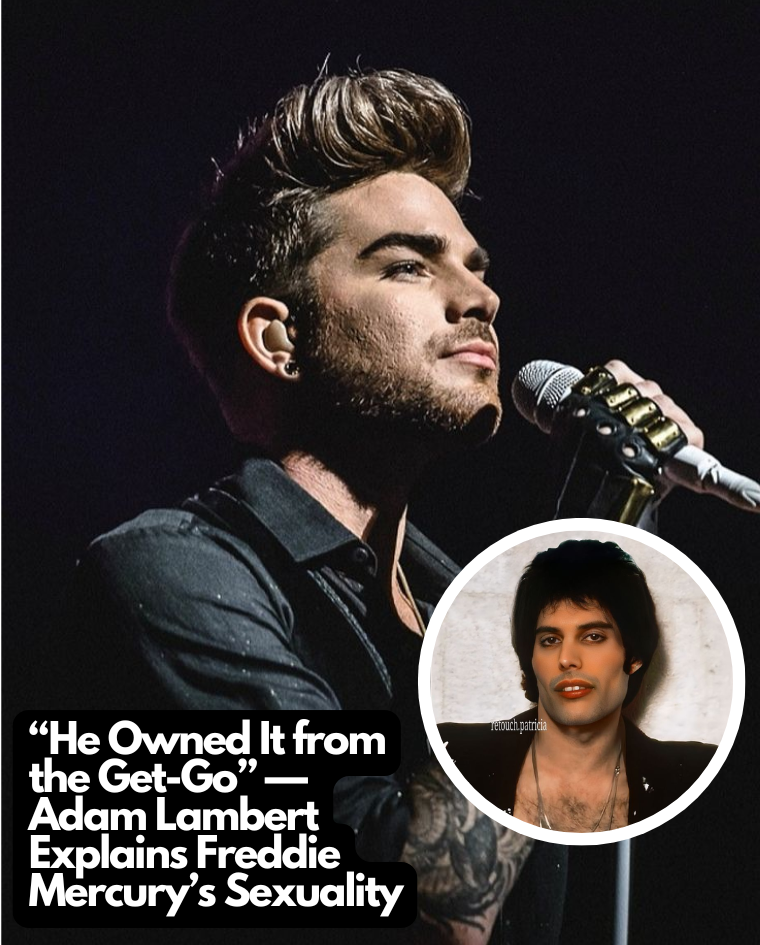
While Mercury never explicitly confirmed his sexual orientation, the rock star’s relationships with both men and women have led many to believe he was either gay or bisexual. In a candid interview with Attitude, Adam Lambert, Queen’s current frontman, shared his thoughts on Freddie’s sexuality, suggesting that the late singer wasn’t as “in the closet” as some might believe.
“I don’t know how ‘in the closet’ Freddie actually was,” Lambert said, offering a fresh perspective on the much-debated topic. While Mercury often answered questions about his sexuality with humor and wit, Lambert pointed out that the Queen icon never outright denied being gay.
“There were interviews where they were asking if he was gay and he said: ‘Yeah as a daffodil… gay as a daffodil,’” Lambert recalled. Though some might have interpreted these remarks as playful or tongue-in-cheek, Freddie never explicitly shut down the question. This open yet elusive response, Lambert suggests, may have been a reflection of the societal climate of the time.
During Mercury’s career, LGBTQ+ issues were rarely discussed in the mainstream media, particularly in rock ‘n’ roll. Lambert, who has since become an outspoken advocate for the LGBTQ+ community, explained that it was a different era — one where sexual identity was a taboo topic. Still, despite the societal pressures of the time, Freddie Mercury remained unapologetically himself.
“He sort of owned it from the get-go,” Lambert said. “Even though it was a time when it was taboo to talk about LGBTQ+ issues, Freddie was always his authentic self.” It’s clear that Mercury was not hiding from his identity, but instead navigating a complex and sometimes hostile landscape that demanded discretion.
Adam Lambert, who has performed with Queen since 2011 as part of Queen + Adam Lambert, has a deep admiration for the icon he replaced. As someone who also broke barriers in his own right, Lambert is uniquely positioned to speak on the topic.
Ultimately, Lambert’s reflections suggest that Freddie Mercury’s sexuality, while never fully defined by labels, was something he embraced with confidence. The fact that he did so with such charisma and style is part of what makes him one of the most iconic figures in music history.
As we continue to celebrate Freddie Mercury’s legacy through Bohemian Rhapsody and Queen’s ongoing influence, it’s important to remember that, while he may not have fit neatly into any one box, he undoubtedly lived and performed as his true self—an inspiration to millions across the globe.